Got a question about your protocol? Talk to a scientist, not a sales rep →

Get 9x the Library From 1 ng - and an Answer From Samples You’d Otherwise Decline

The chemistry is validated down to a 500 pg floor and runs in a single tube from input to sequencing-ready in two hours. We ship evaluation kits free so you can prove it against the chemistry you run now, with no purchase, no quote, and no sales call.

What arrives on your bench: a reagent evaluation kit with carton, foil pouch, reagent tubes in a rack, a PCR tube strip and a 96-well plate, beside the printed technical note
  • Uninformative NIPT rate cut from 1.75% to 0.87% across 2,772 production samples
  • 93 more answered cases a year at that lab’s volume
  • Plasma to sequencer inside a working day
  • Existing analysis pipeline ran unmodified at Nationwide Children’s

What Changes When You Switch

Every kit has a number on the datasheet. The question is what reaches the flow cell.

Running your current kit - where the input is accepted on paper and lost in practice

  • Low input accepted on paper, with most of it lost to conversion
  • Yield rescued with extra cycles, which buys polymerase error and duplication
  • Empirical cycle titration and an extra QC tier just to hold consistency
  • Chimeras and hairpins that turn SV calls into queue items
  • Samples declined at intake
  • Start-site bias and GC dropout eating your target region

Running Watchmaker - the same input, converted instead of rescued

  • 9x the library from the same 1 ng
  • The lowest error of the amp mixes benchmarked, with the biggest drop at C>T
  • A single tube, sequencing-ready in 2 hours, PCR-free capable
  • Up to 90% fewer chimeric reads and hairpin artifacts
  • A validated floor of 500 pg
  • Minimal start-site bias and low dropout in both AT- and GC-rich regions
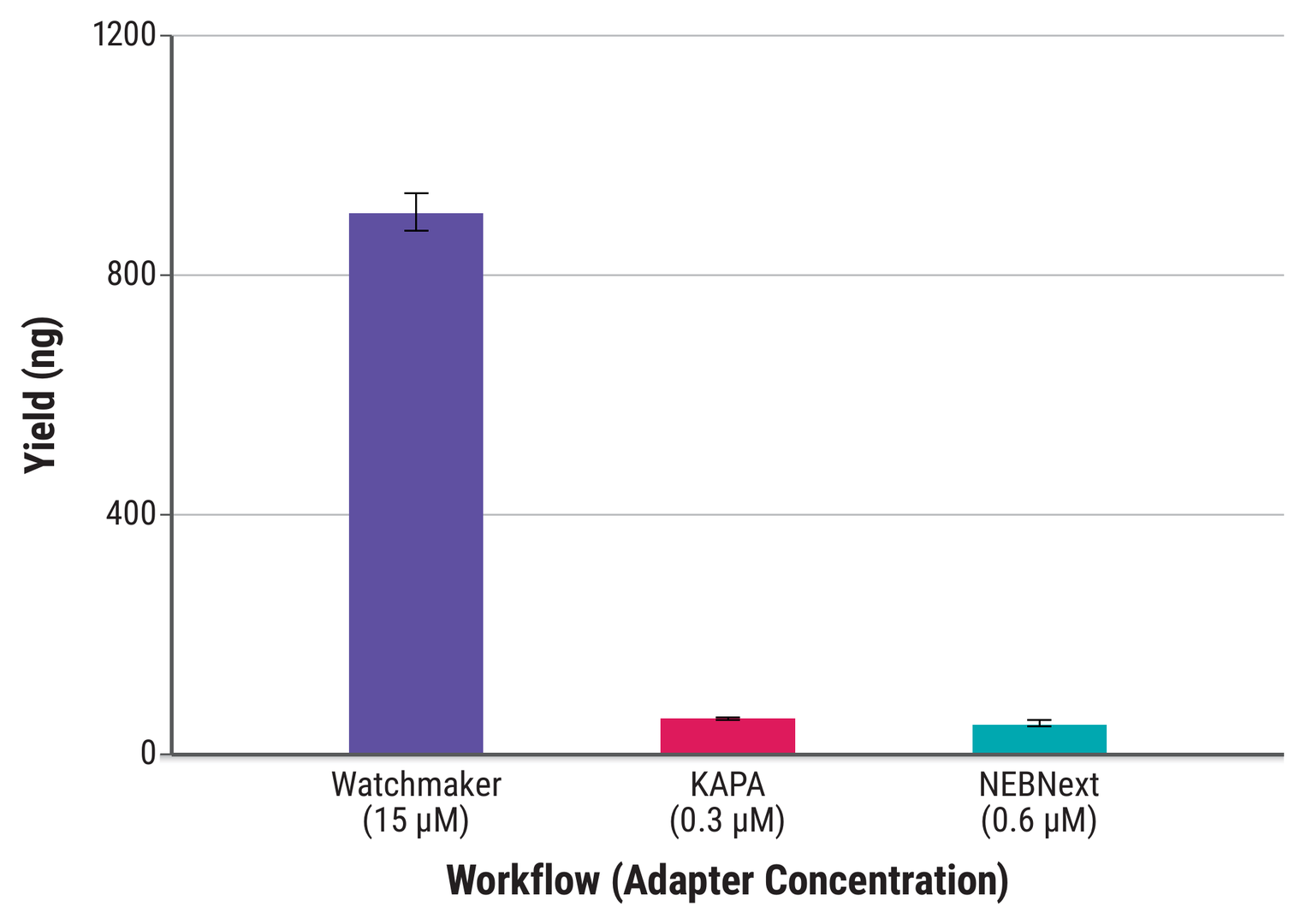
Bar chart. Final library yield in nanograms from 1 ng of cell-free DNA for the Watchmaker workflow and two comparator workflows; the Watchmaker bar is far taller than both.
Tap to enlarge
1 ng Isopure cfDNA, triplicate. Each kit on its own protocol.

No purchase. No quote. No sales call.Kits shipped free, plus the technical note instantly.

Three Labs Switched. None Rebuilt Their Pipelines.

Trisomy test Ltd · Production NIPT

1.75% → 0.87%

After a 62-sample pilot, Trisomy test Ltd verified the switch on 2,772 production samples and watched their uninformative rate fall by half - answers on samples that should have worked all along. Library construction dropped from 5 hours 20 to 4 hours 20, which puts plasma to sequencer inside a working day, and at their volume that works out to 93 more answered cases every year.

Source: Watchmaker NIPT case study.
Nationwide Children’s Hospital · Whole transcriptome

15/16

Nine paediatric tumour biopsies went through four stranded RNA workflows in the hands of four different technicians. The Watchmaker libraries caught 15 of 16 Seraseq control fusions at both standard and low input, where the comparators caught 14 and 9, and they did it with the least hands-on time of the four. Those libraries then ran the hospital’s existing EnFusion pipeline unmodified and clustered by biology rather than by chemistry against a transcriptome database built up over years on the previous kit.

Source: Dr. Katie Miller, AMP 2024.

Wellcome Sanger Institute · Independent and peer-reviewed

20+

Sanger benchmarked more than twenty high-fidelity enzymes for NGS library amplification in a peer-reviewed study and named three. Equinox was one of them, and we did not run, fund or review the work.

Source: Quail et al., Microbial Genomics, April 2024.

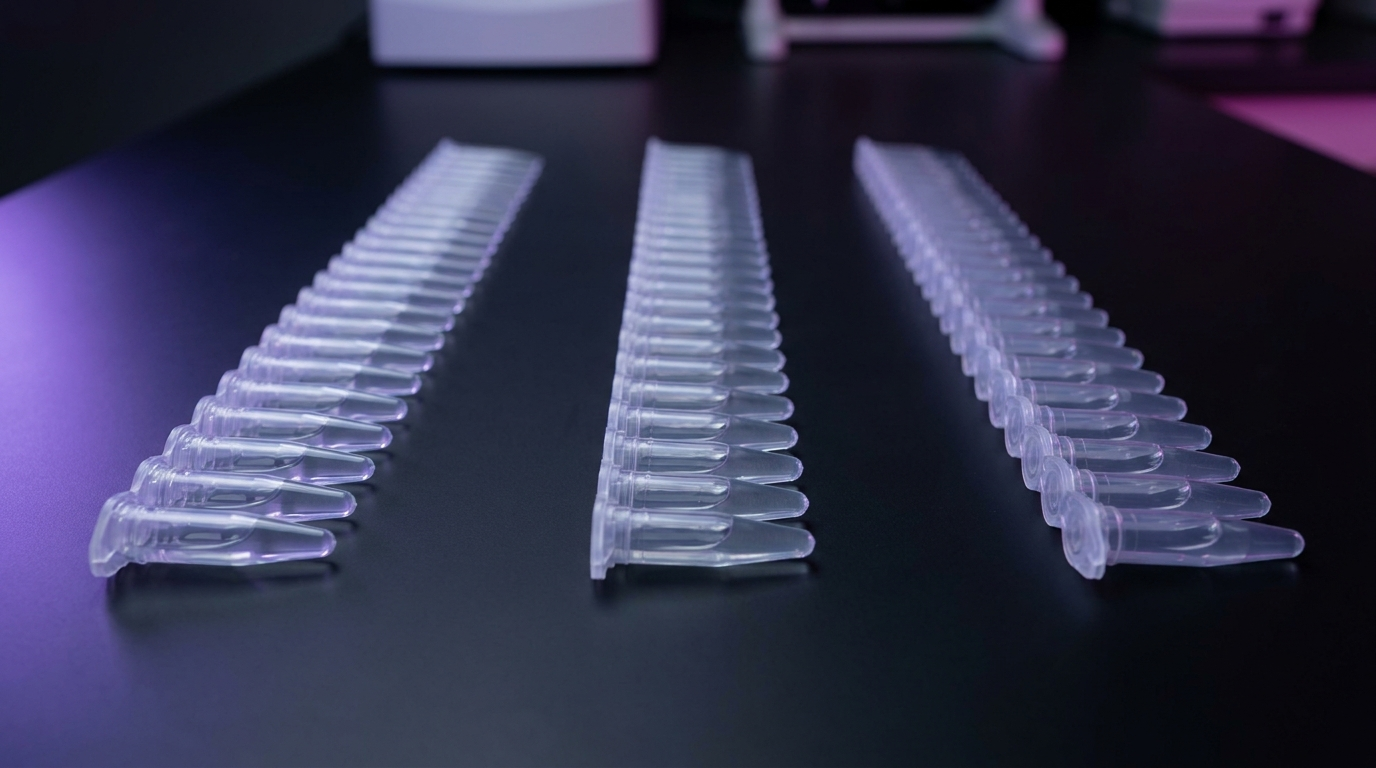
Three parallel sets of PCR tubes on a bench, standing for three library preparations run side by side
Three preparations, one input, one run. What an in-house comparison looks like.

Why Labs Move a Validated Assay Onto This Chemistry

Verified in production before it was trusted

Trisomy test Ltd piloted the chemistry on 62 samples, then verified it on 2,772 more before moving their NIPT assay across - and the uninformative rate halved. That is the standard of proof this kit has already cleared.

Built for damaged, fragmented, scarce input

The floor is validated at 500 pg, the yield is 9x at 1 ng without adding a single PCR cycle, and chimeric and hairpin artifacts drop by up to 90% - so a structural variant call becomes a finding instead of a confirmation queue item.

Free to disprove on your own bench

You run it on your own samples, your own deck and your own pipeline, and a scientist reviews your input range before anything ships. If a different chemistry fits you better, we say so.

The four-page Watchmaker technical note shown as printed spreads carrying the benchmark figures
Every claim above ships with its methods in the technical note.

The Sample You Cannot Recollect

A cfDNA draw at 11 weeks, an FFPE block that’s the last tissue there is, a biopsy that cost a scheduled procedure - the protocol wants 50 to 200 ng and the tube holds a fraction of it. You run it anyway.

Yield at the floor, without borrowing it from fidelity

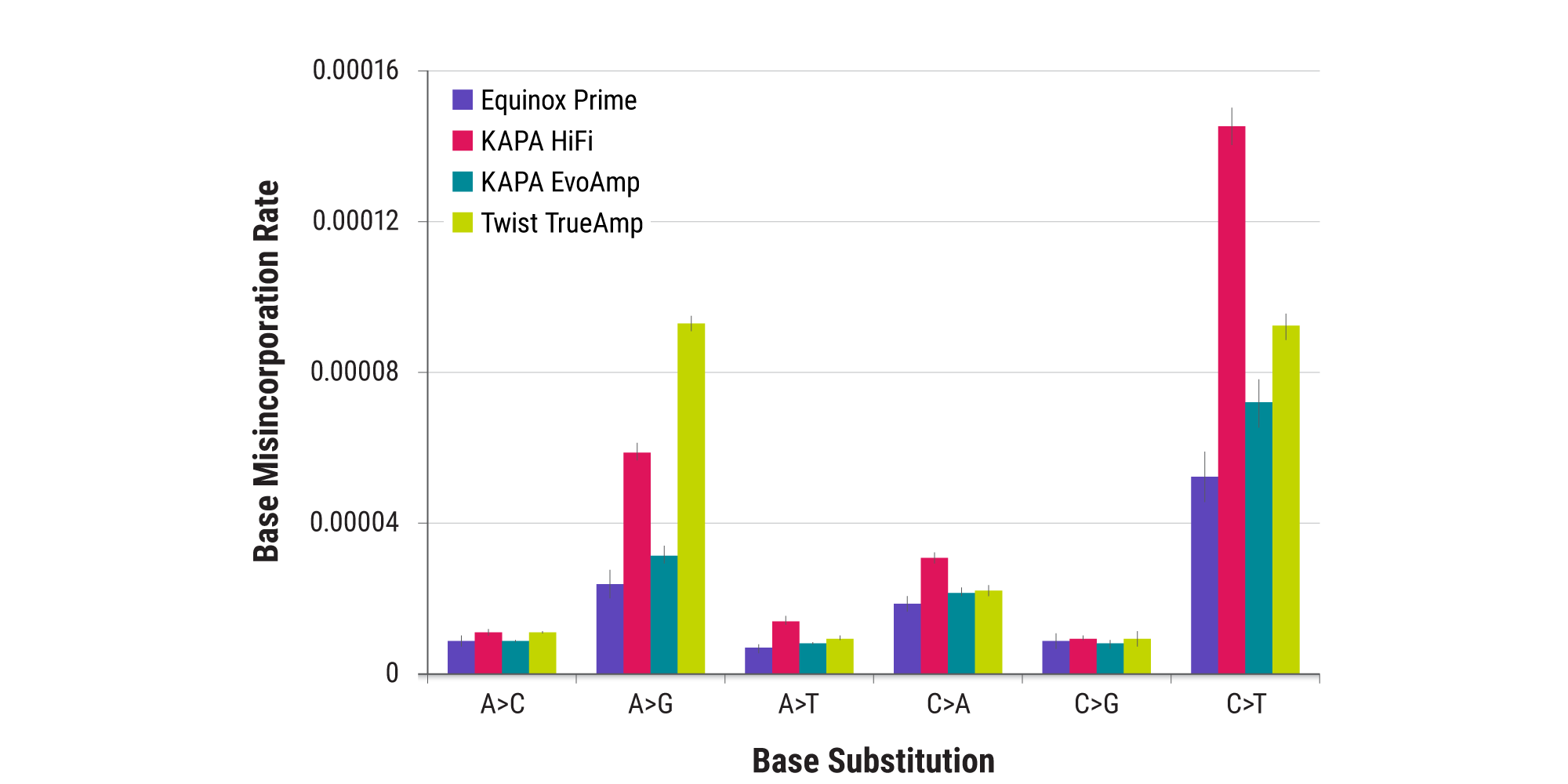
You get 9x at 1 ng, and Equinox Prime showed the lowest error of the amp mixes benchmarked - up to 55% below the highest-error mix.

Coverage at both ends of the genome

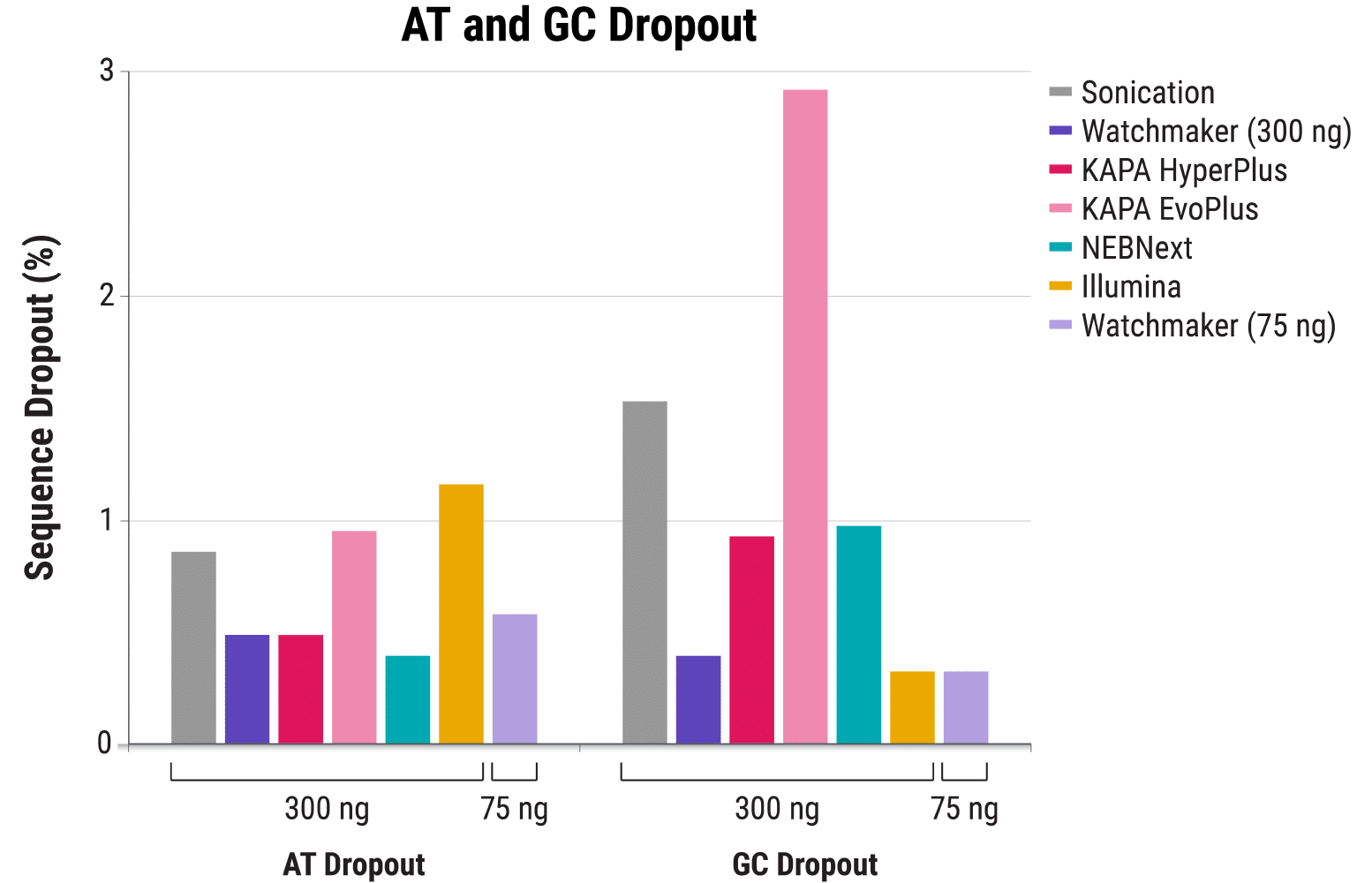
This is the only prep tested low in both AT-rich and GC-rich dropout, and it held that at 75 ng while every comparator ran at 300 ng.

A finished batch inside the shift

Two hours in a single tube, with automation methods published for SciClone G3 NGSx, Biomek i7 and Hamilton Polaris.

Grouped bar chart in two panels, AT dropout and GC dropout, for seven library preparations. The Watchmaker bars are low in both panels while every comparator is low in one panel and high in the other.
Tap to enlarge
NA12878. Comparators at 300 ng, Watchmaker also at 75 ng. The only prep low in both panels.
Dropout is genome you paid to sequence and did not receive.

Tell Us the Sample. We Match the Chemistry.

The Watchmaker library preparation kit range shown as product cartons in a row
One chemistry and one input floor across the whole prep range.

The same chemistry covers cfDNA and liquid biopsy, FFPE and degraded RNA, PCR-free WGS, methylation without bisulfite conversion, and targeted capture, ChIP, metagenomics and viral work - with input floors from 500 pg on the DNA side and 1 ng on RNA with Polaris depletion. One dropdown on the form covers all of it. A scientist reads your input range against the chemistry before anything ships, and if ours isn’t the right fit, we tell you before you spend a run finding out.

No purchase, no quote, no sales call.

Proof on Your Own Bench in Three Steps

1. Start with two fields - your sample type and typical input range. 2. A scientist reviews your protocol and ships kits matched to your samples, free, scientist to scientist. 3. Run the side-by-side on your own deck with your own pipeline and metrics. It’s one day of bench work, and you decide when your data says so.

Every kit ships with the four-page technical note (which downloads the moment you submit), the Trisomy ESHG 2024 recording, SciLifeLab’s PCR-free method for the NovaSeq X, the technical webinar behind the artifact and error data, and rare-variant and FFPE data we haven’t published on this page - full methods included.

Recordings that ship with the kit

Trisomy test Ltd, presented at ESHG 2024
Trisomy test Ltd on cfDNA down to 0.5 ng · ESHG 2024
Anna Lyander, SciLifeLab, at ESHG 2024
SciLifeLab on PCR-free prep for the NovaSeq X · ESHG 2024
Watchmaker technical webinar, hosted by Labroots
The technical webinar behind the artifact and error data

No purchase, no quote, no sales call.

The Performance Is in the Protein

Our founders co-founded two of the businesses whose enzymes this field standardised on, and led R&D at a third. They built the products the field runs on - then rebuilt the enzymes at the point where those products lose data, which is why the margin shows up on cfDNA, FFPE and low input rather than on a clean gDNA control. The enzymes are engineered by directed evolution and manufactured in-house under ISO 13485:2016.

How the enzymes were built → technical note

An engineered enzyme bound to a DNA duplex, rendered as a translucent protein body wrapped around the helix
The protein is what changed. Not the buffer around it.

Supply, Quality and Custom Work

Every lot is released on functional testing rather than analytical spec alone, because that’s what actually holds lot-to-lot behaviour steady inside an assay - and every shipment comes from a single lot, so you QC once regardless of order size. Manufacturing runs under a BSI-certified ISO 13485:2016 quality system, certificate FM 762818, current to January 2029, and you can validate the number yourself at bsigroup.com/ClientDirectory. Custom and OEM work is a core business rather than a favour: lyophilization, tailored fill volumes, private and white label, and bulk fills, running four to eight weeks from PO to delivery with a dedicated project manager and minimums sized for smaller groups.

BSI Certificate of Registration, ISO 13485:2016 quality management system, certificate FM 762818, Watchmaker Genomics Inc., Boulder Colorado

The actual certificate, not a badge we drew

BSI assurance mark and RvA C 122 accreditation mark BSI assurance mark, RvA accreditation C 122

Stocked at the Harvard Biopolymers Facility and the MIT Genome Technology Core. Nine commercial partners build their own products on these enzymes.

Technology and supply partners

Twist Bioscience logo Element Biosciences logo Singular Genomics logo Promega logo Visby Medical logo Volta Labs logo Inocras logo Factorial Biotechnologies logo Molecular Loop logo

Every Number on This Page, With Its Methods

Every claim on this page with its result, method and data owner
ClaimResultMethodWhose data
Library yield9x at 1 ngTriplicate, 1 ng Isopure cfDNA, each kit on its own protocol and adapter concentrationOurs
Dedup UMI coverage+20-30%HD779 Horizon, 0.1% AF, 12-plex 37 kb oncology panel, NovaSeq, 25M read pairsOurs
Polymerase errorUp to 55% lowerEquinox Prime vs three commercial amp mixes, per substitution type; 55% vs the highest-error mix, narrower vs the closestOurs
Chimeric + hairpin artifactsUp to 90% fewerDuplicate libraries at 1, 10, 50, 100 ng gDNA vs two enzymatic frag kits plus sonicationOurs
Control fusions detected15/16Seraseq Fusion RNA Mix v4, standard and low inputNationwide Children’s
Production verificationn=2,772Production NIPT following a 62-sample pilotTrisomy test Ltd
Enzyme benchmarkOne of three named of 20+Peer-reviewed; we did not run, fund or review itSanger (Quail et al., 2024)
Grouped bar chart of base misincorporation rate across six substitution types for four library amplification mixes. The Equinox Prime bar is the shortest in every group and the gap is widest at C to T.
Equinox Prime against three commercial mixes, per substitution.

The Questions Labs Ask

Will switching break comparability with historical data?

No, and it’s been tested at scale. Nationwide Children’s ran Watchmaker libraries through their existing EnFusion pipeline without modifying it, then compared gene expression against a transcriptome database built up over years on their previous chemistry. The samples clustered by biological profile rather than by library chemistry - which is exactly what no batch effect looks like.

How low does input actually go, by sample type?

The DNA kit is validated down to 500 pg, and Trisomy test Ltd ran cfDNA at inputs down to 0.5 ng across their entire 2,772-sample production verification. The DNA Library Prep Kit is specified from 500 pg to 1 µg, the version with Fragmentation runs from under 1 ng to 500 ng, and on the RNA side Polaris Depletion runs from 1 ng with total RNA from 0.25 ng.

What ships in a free evaluation kit, and what does it cost?

Nothing. You get enough reagent for a real side-by-side against your current kit on your own samples, a protocol review with one of our scientists, and the full benchmarking package with methods. Contents depend on your sample type and input range, which is why the form asks. Catalogue pricing is quoted after evaluation because it varies too widely by product and volume for a single number here to be honest - though Trisomy test Ltd cited competitive pricing as one of their three reasons for moving.

How is lot-to-lot and operator variability controlled?

Manufacturing sits inside a BSI-certified ISO 13485:2016 quality system, certificate FM 762818, and every lot is released against functional testing rather than analytical specification alone. Shipments come from a single lot. In the Nationwide Children's Hospital study, 18 libraries prepared by four different technicians showed no correlation between operator and outcome, and Trisomy measured a significantly narrower final library concentration distribution than their reference workflow, which removed the need to re-dilute concentrated libraries before pooling.

Custom and private label, minimums and lead time?

Yes, and it is a core business rather than a favour. Custom formulations including lyophilization, tailored fill volumes, private and white label, branded ready-to-sell kits, and bulk fills for customer-managed fill and finish. Purchase order to delivery runs 4 to 8 weeks for complex customized private-label kits, with a dedicated project manager, flexible terms and accommodating minimum volumes for smaller organizations.

Distributor territories and international shipping?

Kits ship worldwide from Boulder, Colorado, either direct or through the distributor network, so an EMEA address is not a problem. Contents are matched to the sample type and throughput you give us on the form, and a scientist reviews your protocol before anything is packed.

Research use only?

Yes. Watchmaker products are labelled For Research Use Only and are not for use in diagnostic procedures. The quality system is ISO 13485:2016 certified, which supports customers developing their own regulated assays, but that certification applies to our manufacturing rather than converting our products into cleared diagnostics.

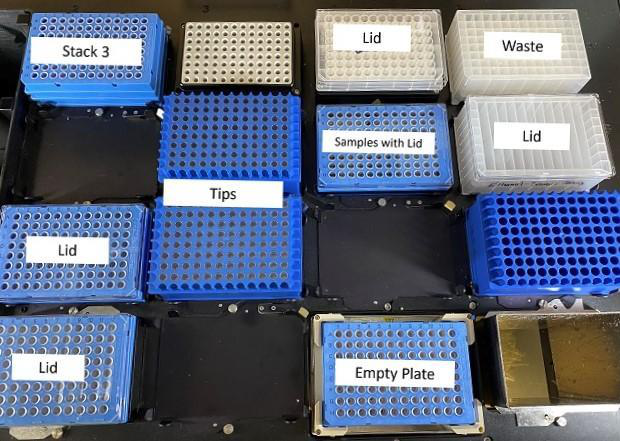
Top-down photograph of a liquid handler deck with labelled plate, tip and waste positions
The evaluation runs on your deck. Methods published for three platforms.

Labs Revisit This Decision Once a Decade. The Ones That Did Got Paid For It.

Your uninformative rate isn’t a constant - it’s the output of a chemistry decision most labs made once and never revisited, because revalidation looked more expensive than the loss.

Trisomy test Ltd revisited it and gained 93 answered cases a year. Nationwide Children’s revisited it and got a day back on every batch without touching their pipeline.

Both of them started exactly where this form starts: free kits and their own samples.

  • 9x at 1 ng
  • 500 pg validated floor
  • sequencing-ready in 2 hours
  • uninformative rate halved in production
Please choose the closest match

No purchase, no quote, no sales call.Kits ship free, and the technical note downloads instantly.